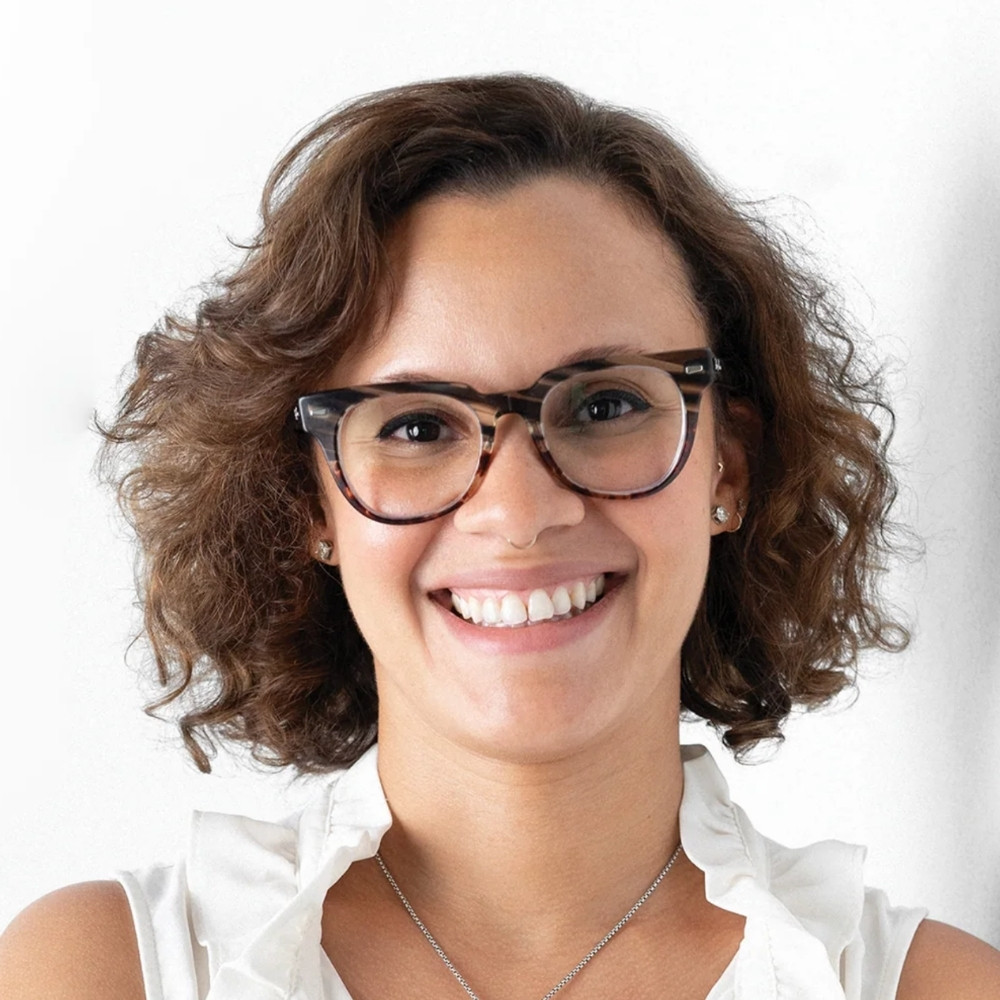

I have always been a creative. Given the choice, I will always pick the work that lets me build a brand, shape a product, take it to market, and have fun the whole way there. That part of me was never in question. What I did not know, for a long time, was myself. Not really. I could tell you what I was good at on paper. I could not tell you who I was, or what I actually wanted.
That turned out to be the most important thing I ever had to learn. The best work I do now, at work and in life, comes from having done it. And it is not something you finish. Getting to know yourself is a continuous exercise, one you keep doing as you grow and change, because the person you are learning about keeps moving.
The degree that was not the dream
I studied Industrial Engineering and graduated Cum Laude. I am proud of the work that took. But if I am honest, it was never the thing I was passionate about. I was good at it, which is not the same as being lit up by it. For years I moved along a track I was capable of walking, without ever asking whether it was mine.
The internship that changed everything
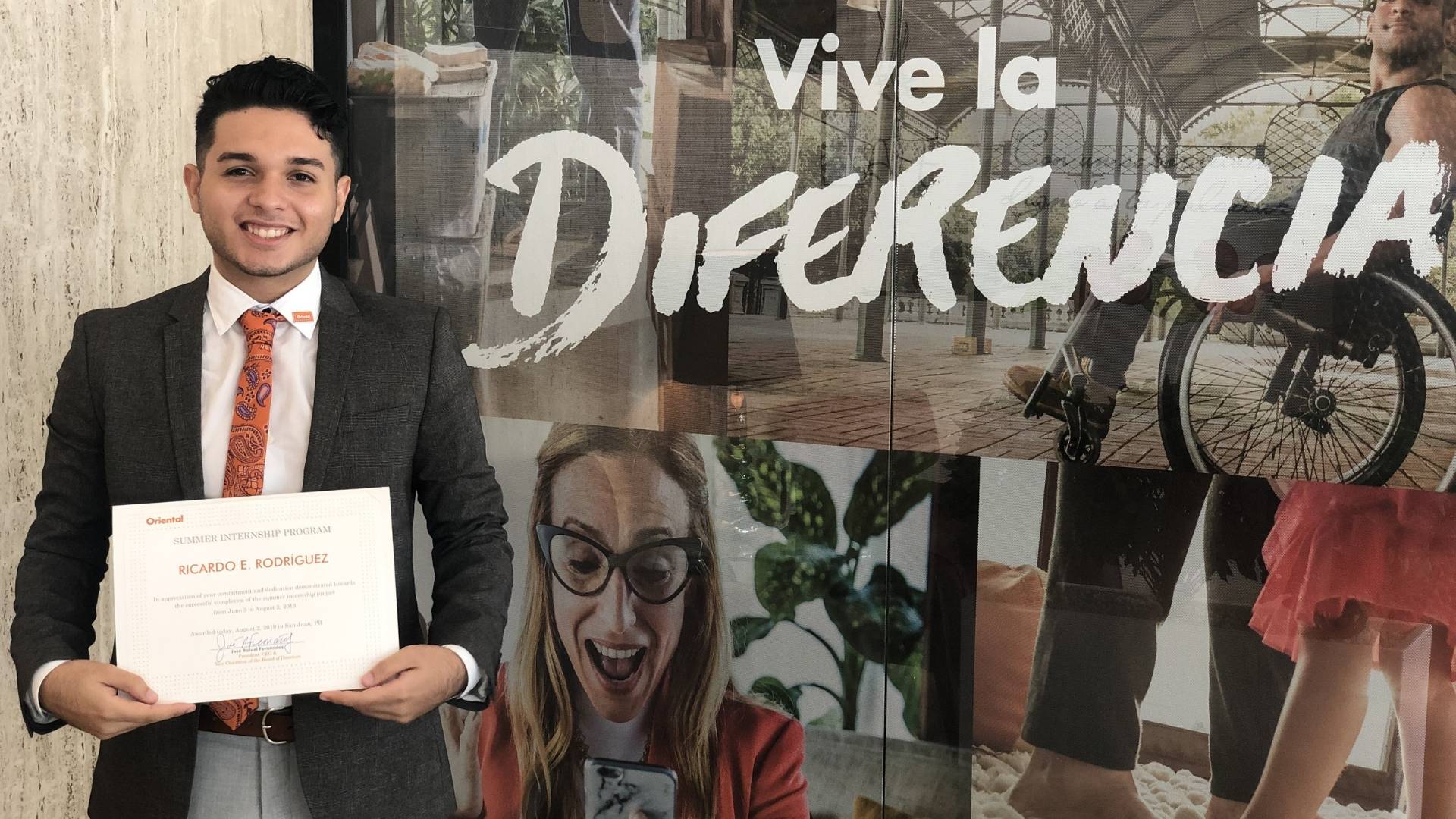
It shifted at Oriental Bank. I took the CliftonStrengths assessment during my internship there in 2019, along with a group session, and then came back for my first grown-up job, the Oriental Trainee Development Program, already holding my results. That is where Suría Toussaint became my mentor and coached me on them one-on-one. She is the one who turned a list of themes into an idea that reorganized how I saw myself: that if you understand your strengths, and your not-so-strengths, you can become the best version of you, at work and in life. It was the first time I got serious about learning myself instead of just performing. And no, before you ask, this piece is not sponsored. I just believe in it this much.
What knowing yourself actually does
This is not only a feelings thing. It shows up in the data. Gallup has found that people who get to use their strengths every day are six times more likely to be engaged at work and three times more likely to report an excellent quality of life. And yet only about a third of people say they get to do what they do best on a given day. Most of us spend our best hours on things that are not our best things. Knowing yourself is how you start to close that gap.
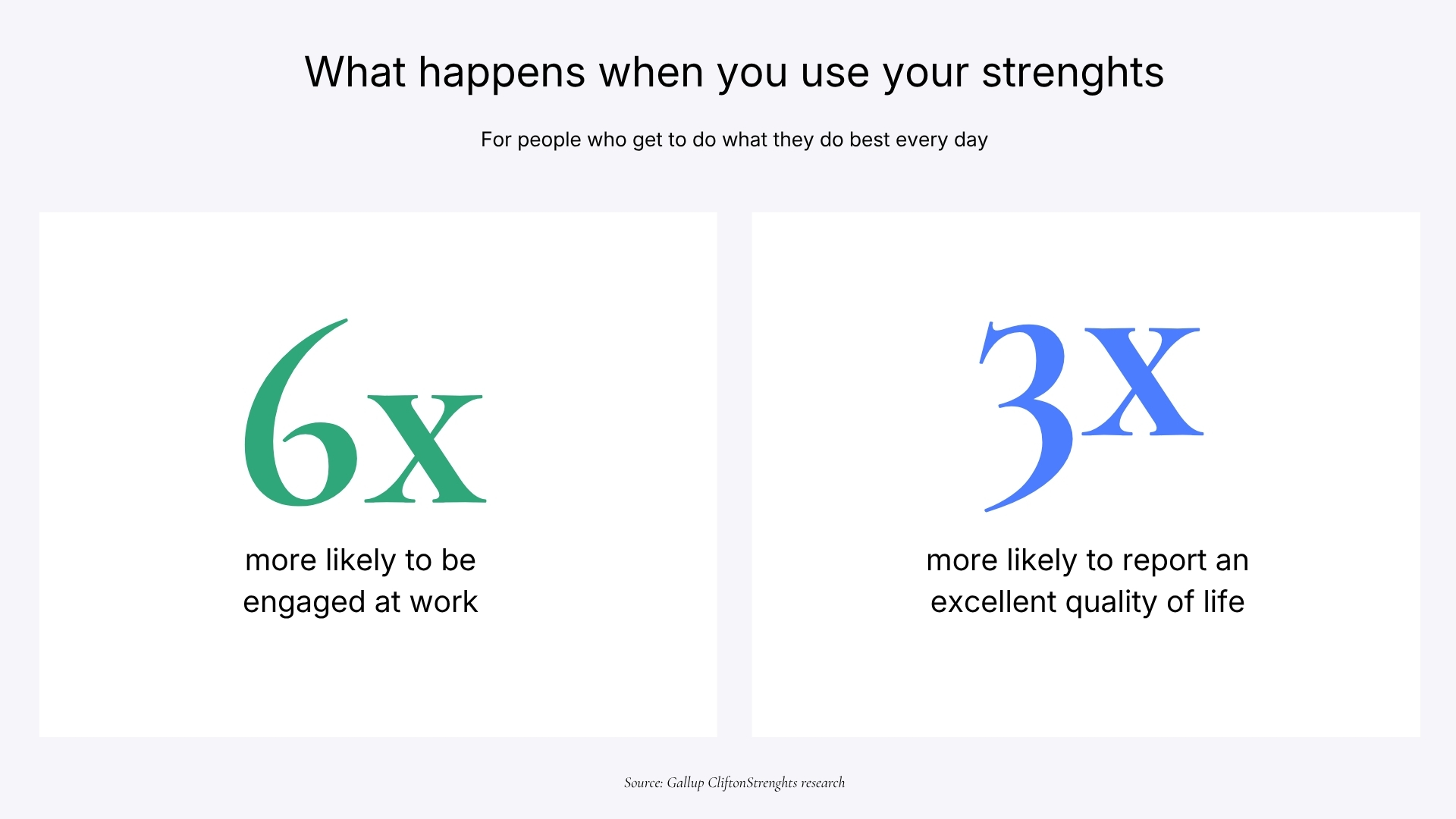
The payoff of working from your strengths, according to Gallup's research.
The things I do to know myself
Knowing yourself is not a one-time test. It is a practice, and mine is made of small, repeatable things.
I write every day. Not to publish, just to hear what I actually think. I read personal growth, and I read about manifestation, because both keep me pointed at who I want to become. I am careful about who and what I follow, since your inputs quietly become your thoughts. And I stop, on purpose, to notice real things: a flower, the sky at dusk, a tree I usually walk right past. Silence counts too. Done consistently, these give me time alone with my inner creator, mi pequeño creador, and that is where I actually figure things out.
It works. Recently I made a decision, and I will be honest, without a clear plan, to change my environment at work and go after something different, because I was not feeling fulfilled. I could only make that call because I had spent years learning to hear myself clearly enough to trust it.
The tool I keep coming back to
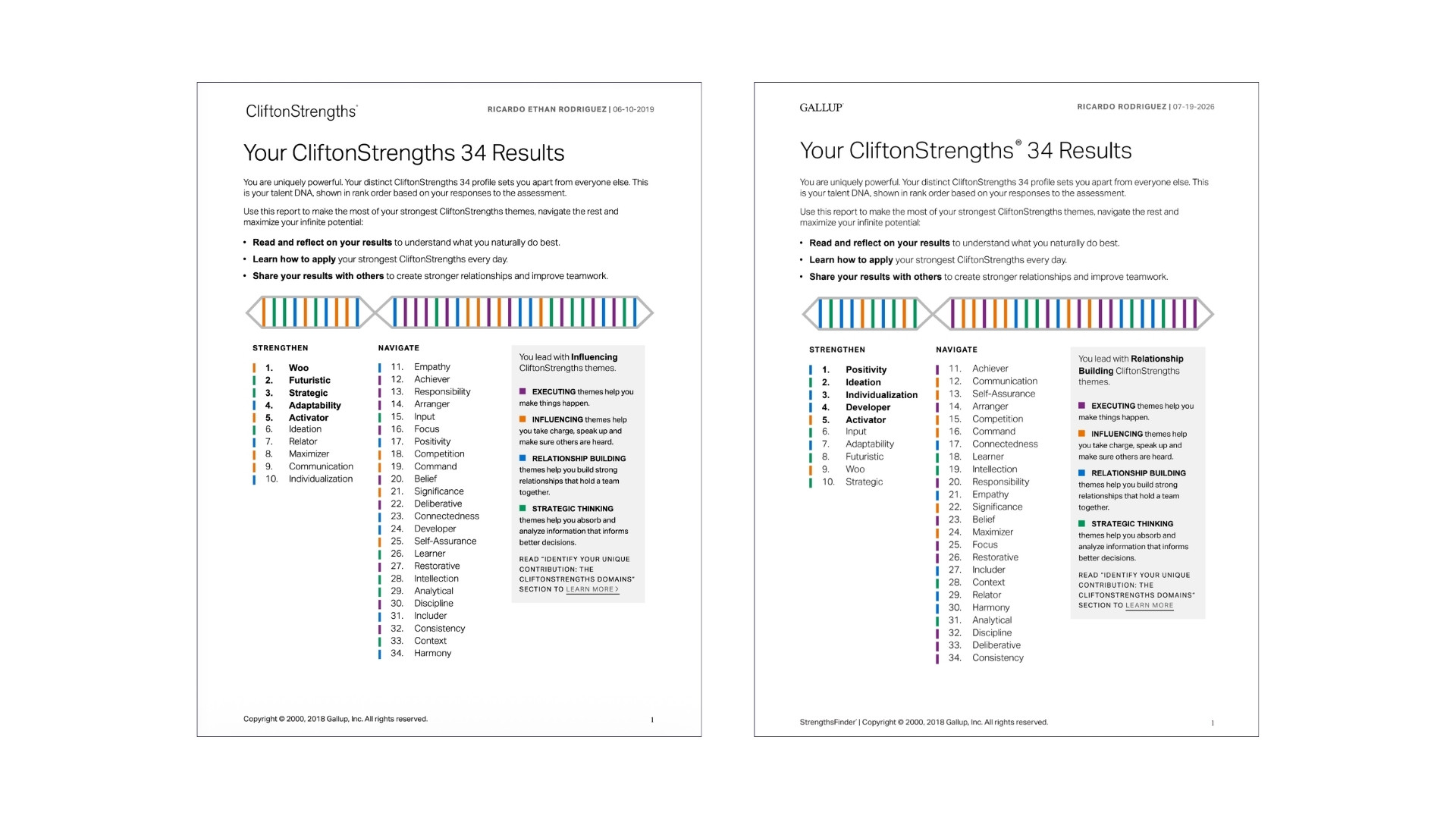
Of everything I have used, the one I recommend most is CliftonStrengths, the Gallup assessment Suría introduced me to. It sorts your natural talents into a ranked set of themes, grouped into how you think, relate, influence, and get things done. What I loved is that it does not tell you what is wrong with you. It tells you what is most right, and how to lean into it. I loved it enough that since 2019 I have talked my aunt, my husband, and more friends than I can count into taking it. One of my top themes is WOO, Winning Others Over, which, if you know me, explains a lot.
Then and now
I first took it in 2019, and I took it again in 2026. The results moved, which makes sense, because how you express your strengths changes as you grow. In 2019 my profile leaned toward Influencing, the themes about connecting with people and getting things moving. By 2026 it leaned toward Relationship Building, the themes about growing a team and holding it together. Here they are, side by side.
Then, my first results in 2019
- Woo
- Futuristic
- Strategic
- Adaptability
- Activator
Now, my most recent results in 2026
- Positivity
- Ideation
- Individualization
- Developer
- Activator
The shift surprised me, and then it did not. The engine is the same. Activator, my drive to decide and move, sat at 5th both times and did not budge. What changed is where it points. In 2019 I led with Influencing, the part of me that walks into a room and wins people over, always hunting the next opportunity. By 2026 my old number one, WOO, had slid to 9th, and I now lead with Relationship Building instead. Positivity, once a quiet 17th, is my single strongest theme today. Developer, the pull to grow the people around me, jumped from 24th to 4th. Ideation climbed into the top three. Read together it tells one clear story: I used to be built to find the opportunity, and now I am built to grow the thing I already started. I went full time as a founder that same summer, and my strengths seem to have known before I did.
One honest tradeoff came with it. The part of me that used to slow down and double-check before committing got quieter, while my urge to move stayed exactly where it was. I know this about myself now, and I am grateful I do not have to fix it alone. I have people, who have been in my life for years, and I bring the big calls to them before I make them. Sometimes they tell me to slow down. Sometimes they say go. Either way, I get a second set of eyes I can trust, and that has become part of how I make decisions instead of something I hope happens on its own.
A conversation with Suría
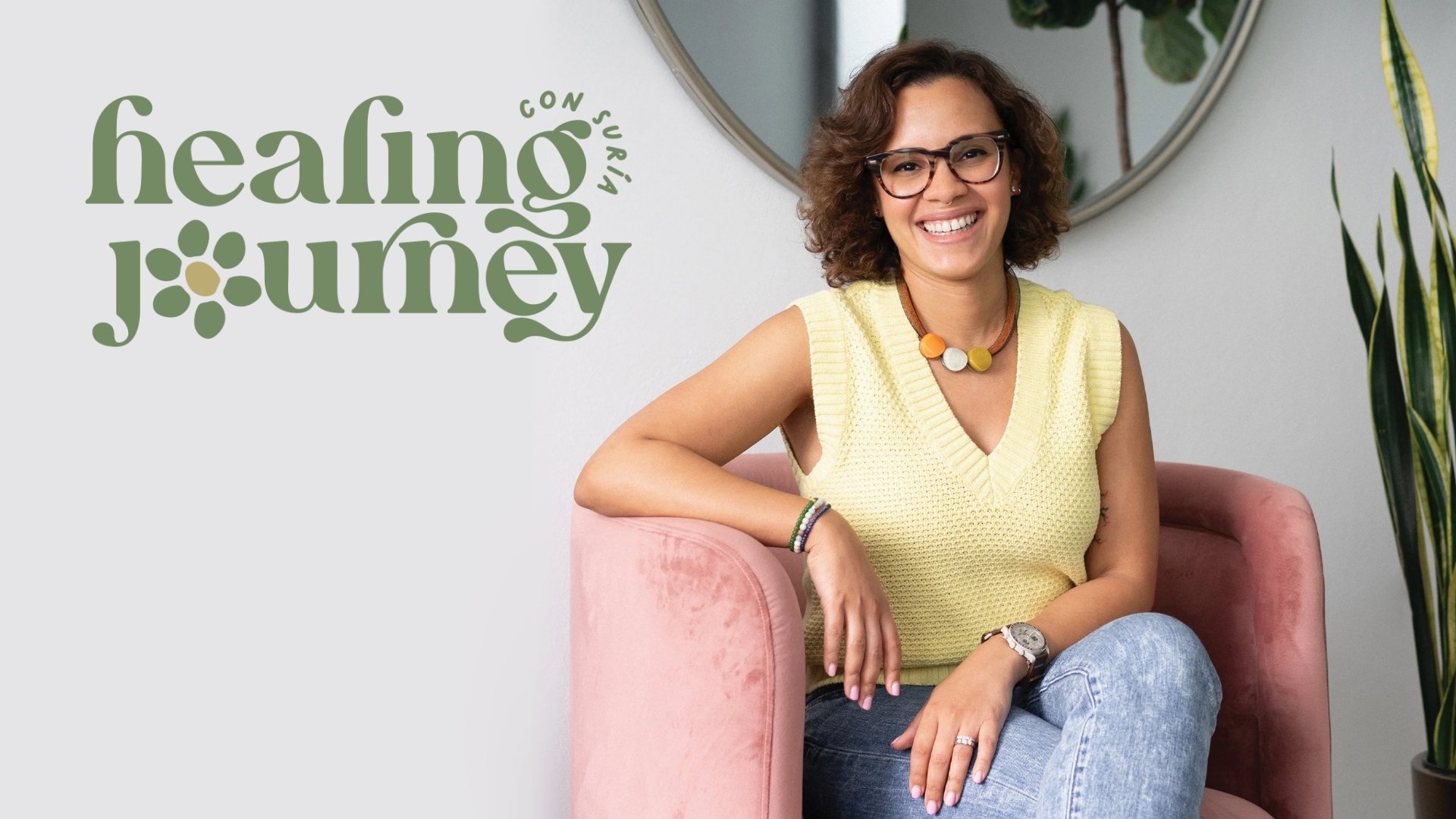
Since Suría is the person who started all of this for me, I asked her to join this piece and answer a few questions. A little about her: Suría Toussaint is a Certified Integrative Health & Wellness Coach and a Gallup-Certified Strengths Coach, with a Master's in Industrial-Organizational Psychology from the University of Puerto Rico and more than a decade of guiding people through their professional development. Out of that work she built Healing Journey con Suría, her practice for helping people prioritize themselves and live their best life, personally and professionally. I did not stick to a script for this conversation. I let it flow, and this is where it went.
What is Gallup’s CliftonStrengths Assessment, and what does it actually measure?
It's basically a standardized test, and it measures patterns or tendencies, in your natural talents. Natural talents is almost redundant to say, because if something is a talent for you, it's because it comes to you innately. Most of the time, you don't even know why you're the way you are, it's just natural to you. That's what CliftonStrengths is looking for: which talents are recurring and most significant or most present in you. To help people centralize talents in categories, the assessment groups all talents in four domains: Relationship Building, Influencing, Execution, and Strategic Thinking. So, it doesn't measure your personality, your skills or your abilities. It measures what you’re good at. And the idea is that you can put a name, like I like to say, to the things you're naturally good at, and be intentional about it. By adding intentional practice and knowledge, this will help you strengthen those natural talents into strengths.
Why did you think it was so important for someone like me, an intern, to take this test?
The organization that we worked in already used this assessment, and they had developed a culture that focuses on what a person does well, instead of the things that don't come naturally to them. Looking at an internship, a trainee program, and honestly any role, but especially with young people, it's about helping you know yourself so you can be intentional in how you work, execute, relate to people, influence, and how you think strategically. Think about it, an intern is someone still figuring out if they studied the right thing, if they even like what they studied, where they want to take their career wether it’s in banking, health, tech, pharmacy… there are so so many options. This kind of assessment helps you know yourself better and gives you insight on why you're good at certain things, or why certain things come so easily to you. It's the same once you're a full-time employee. Maybe your career path is a little clearer by then, but knowing your talents still helps you execute your goals more effectively, because you know what you’re good at, which projects or tasks seem more attractive to you, and you're more intentional about how you show up.
Is it wrong to consciously choose when to use a talent, even one that's not near the top of your list?
Not at all, and honestly, that's exactly what helps a talent become a strength -along with the knowledge, skills and awareness-. Being intentional about using your talents is what turns them into strengths, as long as they lead you to success. Because for Gallup, there's no such thing as a weakness. A weakness is just a talent that's supposed to help you succeed but gets in your own way instead. Take my Focus for example, it's my number five talent. Let’s say that instead of using it to lock in and get work done (which will
help me exceed in my work), I use it in a way that I stop considering anything else. Here, my Focus is becoming an obstacle, not a strength, because I've closed myself off.
To answer your question, in your case, you know you have WOO as your 9th talent. Imagine you're walking into a networking event where you need to meet people to connect and pitch your business proposal. You automatically think of being intentional about using your WOO on purpose. By doing this, it’s very probable that you walk away from that networking event with real contacts or your pitch lands, and that's you using your talent as a strength.
What would you tell a founder or CEO reading this?
I think every organization should do this, but especially small business owners, because of how much insight it gives you on what you’re good
at and how to capitalize on that. As a business owner myself, knowing my talents makes me intentional about noticing when I'm getting in my own way and when I'm using what I have to actually get where I want to go. Knowing your talents help you lead better, make better decisions, and manage where your energy goes during the day. And all of that is part of your well-being when you really look at it, because you feel good doing the work you're built for, you feel proud of the relationships you're building, and about how you're developing your people.
Aside from this, knowing your talents is not just for the professional world. Before my husband and I got married, I had him take the assessment, because I wanted to understand him and I wanted him to understand me. His results came back with Belief as a top talent and just knowing that made me a lot more patient with the way he manages things or gets things done. The same thing happened when he understood my Futuristic -which before was difficult for him to understand how I analyzed situations-.
So, when a business owner implements the CliftonStrengths assessment with their team, they get to know their people in another way. You know in what roles or functions to place them, which projects to assign them to lead, because you know who leads strategic thinking, who's built for making the execution happen, who leads with relationships or influence.
Why does this need a real conversation? Why can't someone just run their results through AI?
In a coaching session, we have the opportunity to talk about you, it’s not just covering the assessment’s report question by question. We just start talking, and you start telling me about yourself. I'll ask something like, “When you do this, what are you thinking?”, “To get this done, how do you actually do it?” or “How does achieving this make you feel?”. And by the time we’ve finished talking, I can see how you’ve basically told me, in your own words, the talents that are right there in the report.
I let people talk, and then I tie it together, and they say, “How did you do that?” and I'm just listening, looking at the report, and finding where they line up. The idea of coaching is to support you in finding the answers you need to exceed, by guiding the conversation with intentional questions.
Let’s use your Top 10 talents as an example. If you want to use your Activator in a way that supports your excellence at work, you can be intentional in using other talents that help your Activator not become an obstacle. In your Top 10 talents you have Activator, Adaptability, Individualization, Ideation and Futuristic. Ideation and Futuristic get you excited about every possibility, and Activator, which is about influencing, pushes you to jump in and act. But Adaptability lets you pull back and read the room, and Individualization lets you notice what makes this specific person tick, how they work, how they think, how they act. That's what lets you observe and listen first, so your Adaptability can come in and say, “let me be flexible here”, so people feel comfortable, so your team is actually effective, and so your Activator doesn't become an obstacle in your path.
I told you I've always struggled with consistency. What did you say to that?
You have Achiever, which is your 11th talent. Even though it’s not in your Top 10, it's still there, and it means whatever you set your mind to, you will achieve it. If you put your purpose behind everything you do and combine that with your Achiever, you get to what you set out to do, maybe not in a consistent way, but you get it done. So instead of chasing consistency, which isn't going to come naturally to you, chase the fire that makes you act, and that fire is your purpose. Consistency, the actual talent, means something different than what you were describing. It's doing things the same every time, waking up every Monday at 8:00a.m. and posting on social media, sitting down every Tuesday at the same time to do a certain task, etc. That's not you, and it's not going to be you, because you also have Individualization and Ideation, and that combination is not going to make you consistent in that literal sense. I have Individualization at number one and Consistency at number ten myself, and my version of consistency is that I'm always consistent about treating people exactly how they want to be treated. That's where my consistency lives. Yours might live somewhere else too, once you stop trying to force it into a shape it was never going to take.
Anything else you want to say?
I think I've said it all. Really, CliftonStrengths is so much more than an assessment or a tool. I could talk for hours about this, and it fascinates me. So I think everyone should invest, even just once, in taking the assessment and having a real coaching conversation about it. That way they can understand themselves better, be intentional with their personal purpose and with whatever they decide to do, professionally or personally.
Where to find Suría
If any of this sounds like you, spend some time with Suría's work. You can find her at Healing Journey con Suría, where she coaches people toward a healthier, more connected and purposeful life, and where she links to where she writes and shares. She changed the way I see myself. She might do the same for you.
Getting to know yourself is not a project you finish. It is a practice you keep. Every hour I have spent on it has paid me back, at work and everywhere else. So start with one small thing, a page written tonight or the assessment taken this week, and see what you find.